FuturHist is a research project aiming to demonstrate that energy efficiency and heritage preservation are not mutually exclusive, but can be successfully combined through well-adapted retrofit strategies.
The project is co-funded by the European Union and UKRI and involves academics and practitioners from leading universities and organisations across Europe, including Eurac Research, University of Innsbruck, Aalborg University, Uppsala University, Kraków University of Technology, Edinburgh World Heritage, and ICOMOS.
As a partner of FuturHist, INTBAU supports the translation of research into real-world practice, contributing to the energy transition of historic buildings – retaining their cultural value and meeting contemporary performance requirements. Through this shared commitment, FuturHist provides knowledge, methodologies, and tested solutions that support INTBAU’s global network of practitioners in Europe and beyond in advancing traditional building, architecture, and urbanism within today’s built environment.
FuturHist Retrofit Academy
As Europe moves toward a carbon-neutral future, the refurbishment of historic buildings presents a unique challenge: how do we achieve modern energy standards without losing cultural identity? The FuturHist Retrofit Academy offers a specialised, two-stage capacity-building programme designed to bridge the gap between heritage conservation and high-performance energy efficiency.
Co-organised by the Sendzimir Foundation and ICOMOS, with the participation of academic and technological partners involved in the Horizon Europe FuturHist project, this programme provides practitioners with the methodologies, tools, and innovative solutions developed within the project.
Who is the programme for?
This programme is specifically tailored for professionals operating within the European Union and associated countries who are looking to specialise in the sensitive retrofit of the historic building stock:
- Architects and Urban Designers
- Civil and Energy Engineers
- Building Sector Specialists (Conservation officers, energy auditors, and project managers)
- Emerging Professionals looking to enter the sustainable heritage sector.
What are the benefits of taking part?
By joining the FuturHist Retrofit Academy, you will:
- Gain Competitive Expertise: Master the “typological approach” to renovation – moving from time-consuming and expensive, one-off case studies to scalable, efficient retrofit models.
- Access Cutting-Edge Tech: Be among the first to explore and test the FuturHist Toolkit, a step-by-step decision support system that streamlines the planning of energy retrofits.
- Network Internationally: Build relationships with top-tier experts from across Europe, including partners from the FuturHist Horizon Europe project consortium.
- Future-Proof Your Career: Equip yourself with the skills to meet stringent European energy policies and green building standards for heritage assets.
What will you learn?
The curriculum is designed to transform theoretical knowledge into practical, billable skills:
- Technical Solutions: Deep dives into innovative passive solutions (biomaterials, self-healing lime renders, and window retrofits) and active systems (HVAC and Renewable Energy integration).
- Practical Implementation: Implement the knowledge gained to the real-life case study buildings in Krakow, Poland and other participating countries.
- Simulation & Assessment: Gain hands-on experience with hygrothermal simulation of building envelopes and Life-Cycle Assessment (LCA).
- Decision-Making: Learn a multidimensional methodology to balance energy performance, occupant comfort, and conservation compatibility.
- Policy & Standards: Navigate the legal and technical barriers of European building stock renovation.
Programme Structure
The FuturHist Retrofit Academy is designed as a two-step capacity-building programme.
Stage 1: E-learning Course
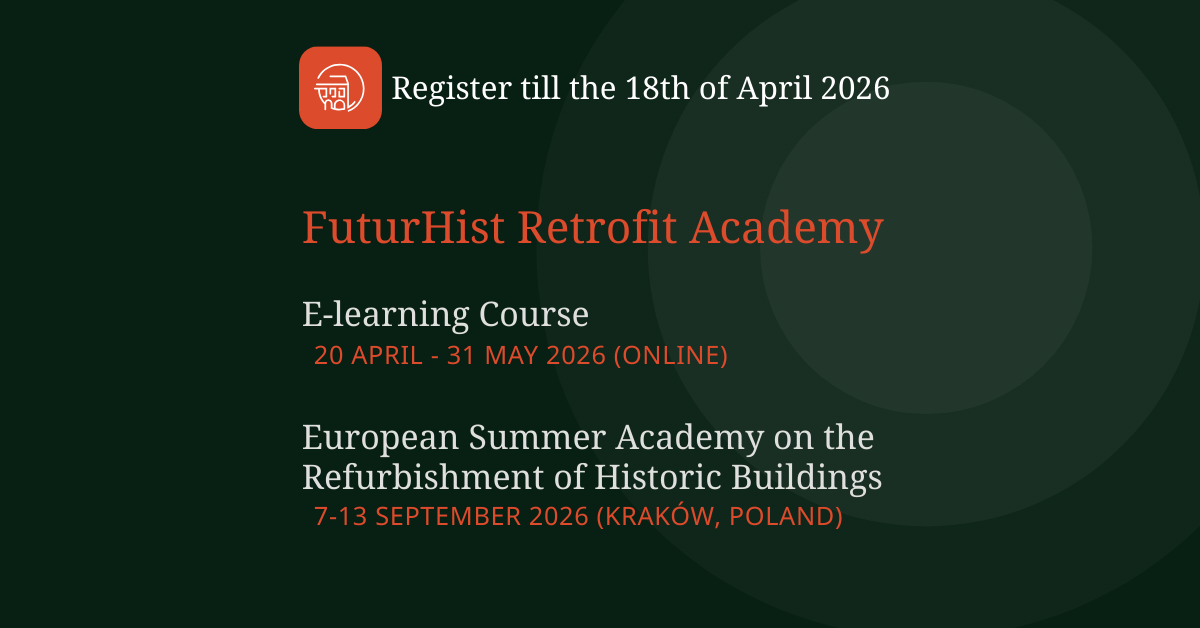
Date: 20 April – 31 May 2026 | Format: Online | Access: Open to all applicants
This intensive six-week course provides the practical knowledge required for modern retrofit projects on renovation practices, energy efficiency, data collection and assessment for better-informed decision-making, as well as basic skills in hygrothermal simulation of building envelopes.
Various retrofitting solutions will be presented in the context of building physics and material properties. Both traditional and innovative passive solutions (e.g. recycled insulation materials, biomaterials, self-healing materials, and window retrofits) will be discussed in terms of their conservation compatibility and energy efficiency. Active retrofit solutions will also be addressed, including the assessment of HVAC systems and guidelines for integrating renewable energy sources (RES).
The course will demand around 30 hours of work. The participants will be able to organise their work independently, according to their availability during the six-week course. To complete the course and receive a certificate, one must master the knowledge contained in the training materials, actively participate in expert-moderated discussions on the course website, and complete at least two tasks by the designated deadlines. If you prefer, you can apply only to the e-learning stage. The participation in the online course is free of charge.
The E-learning Course is structured into three core modules. Participants may navigate the modules according to their specific interests, without a mandatory sequence.
Module 1: Baseline
- Challenges & Potentials – introduction and overview of European policies, guidelines, and retrofitting tools
- Assessment Categories and KPIs – heritage significance, energy performance, quality indicators, LCA, and financial aspects
- European Standard – presentation of the normative background
- Building Typologies – definition and presentation of FuturHist typologies and demo cases in Córdoba, Edinburgh, Kraków, and Linköping
Module 2: FuturHist Approach
- Renovation Practices – overview of current renovation practices
- FuturHist Toolkit – introduction to innovative FuturHist typology approach, a multidimensional decision-making methodology, and a decision support system
Module 3: Retrofitting Solutions
- Building Physics & Material Properties – energy efficiency, durability, conservation compatibility, biomaterials, self-healing materials, recycled materials, and aerogels
- Building Survey and Assessment under EN 16883:2017 and Beyond – data collection for better-informed decisions and the FuturHist Toolkit
- Conservation-Compatible Passive Solutions – potential applications and limitations of insulation systems and materials, best practices in window retrofit, and an introduction to building envelope hygrothermal simulation
- Conservation-Compatible Active Solutions – evaluation of active retrofit systems (HVAC and RES) and guidelines for their integration
Participants will be granted access to the E-learning platform through individual accounts, which will be activated and distributed shortly before the course begins.
Stage 2: European Summer Academy on the Refurbishment of Historic Buildings
Date: 7 – 13 September 2026 | Location: Kraków, Poland | Access: Exclusive to the top 20 E-learning alumni. The highest-achieving and the most engaged participants from Stage 1 will be invited to this fully immersive, 7-day practical training.
This interactive and practice-oriented programme will enable the exchange of best practices among participants. Working on real case-study buildings, participants will develop refurbishment and retrofit concepts in dialogue with local stakeholders.
A novel multidimensional decision-making methodology and the initial version of the step-by-step decision support system (the FuturHist Toolkit) will be presented and tested.
The curriculum will include building diagnosis, objective setting, identification of compatible passive and active solutions, monitoring and control systems, building performance calculations, and life-cycle assessment (LCA). The adaptation and transferability of the FuturHist methodology and solutions to other building typologies and contexts will also be discussed.
To provide the best environment for knowledge and experience sharing in the recruitment process, we will take into account the diversity of represented countries and institutions, as well as the professional motivation described in the registration form. This stage is directed in particular to individuals professionally involved in the future-proofing of European heritage buildings. The participation in the training is free of charge.
Who is involved in the programme development and teaching?
The Sendzimir Foundation/INTBAU:
Tomasz Jeleński – FuturHist Retrofit Academy academic coordinator
Eurac Research:
Daniel Herrera
Elena Poma
Alexandra Troi
Federico Trentin
Edinburgh World Heritage:
Yann Grandgirard
Gary Cunningham
International Council on Monuments and Sites:
Philipp Hesse
Aalborg University:
Ernst Jan de Place Hansen
Peter Scheutz
Innsbruck University:
Marianna Muchorowska
Michele Bianchi Janetti
Krakow University of Technology:
Kinga Racoń-Leja
Krzysztof Barnaś
Uppsala University:
Petra Eriksson
Gustaf Leijonhufvud
Calchèra San Giorgio:
Anna Stefani
The Summer Academy will be moderated by Agnieszka Czachowska (The Sendzimir Foundation)
Ready to lead the change in European built heritage future-proofing?
Fill in the registration form by the 18th of April 2026