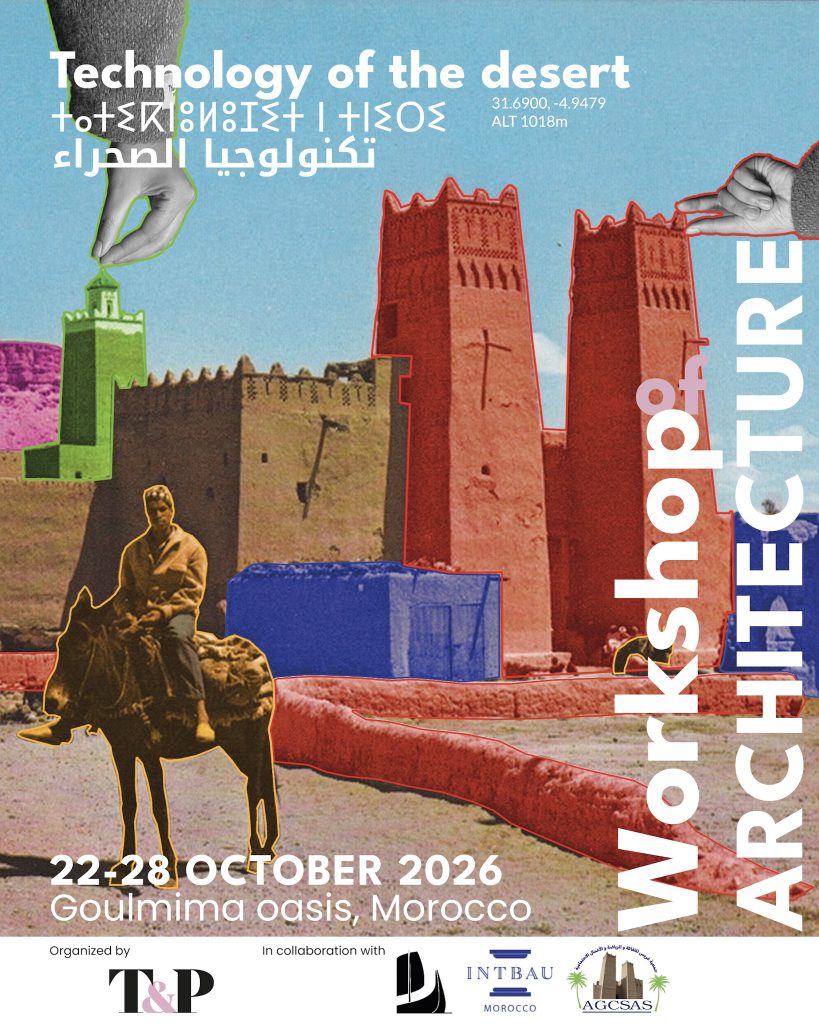
Technology of the Desert | Workshop of architectural, urban and territorial design
22–28 October 2026 – Goulmima oasis, Morocco 31.6900, -4.9479 ALT 1018m
Technology of the Desert is a one-week architectural, urban and territorial design workshop held in the oasis of Goulmima, in southeastern Morocco, from 22 to 28 October 2026. It is organized by Taller & Patrimoine (Paris) in partnership with the cultural association Nostoi (Milan), INTBAU Morocco and the Association Ghriss pour la culture, le sport et les activités sociales, and it brings together students, researchers, architects, and local inhabitants around a single question: how did a society make habitable land out of scarcity, and what can that intelligence teach us today?
The issue: the oasis as negotiated territory
The vernacular architecture of southern Morocco — particularly its ksour and kasbahs — has been the subject of extensive scholarly documentation. Numerous publications provide detailed descriptions of these settlements through maps, measured drawings, photographs, and architectural surveys. While the tangible heritage of these remarkable earthen settlements has been relatively well documented, a fundamental component of this heritage remains largely absent from the existing literature: its immaterial architectural knowledge. Rather than viewing vernacular architecture solely as a historical legacy, the workshop will argue for its continued relevance as a source of technological innovation, environmental adaptation, cultural continuity, and architectural identity in twenty-first-century Morocco.
Oases are territories born from an agreement between people on how to manage a scarce resource: water. They are, in this sense, not only agricultural landscapes in the desert but negotiated ones — ecological, economic, material, and socio-cultural systems bound together by collective decisions, continuously renewed. The workshop seeks to understand the oasis as precisely such an interconnected territory, and to ask what kind of settlement these conditions produced.
To read a territory as layered and complex as the oasis, we had to develop a methodology capable of unfolding all these layers, a transversal method able to grasp the system as a whole. The equilibrium of the oasis relies on a rhythm between water, agriculture, and the built environment. In line with the issue this workshop addresses, we propose to organize our analysis around three main lenses: resource, knowledge, and built environment. Each professor engages with one of these categories, bringing their own expertise and sensibility to it – forming together a collective intelligence attuned to that of the territory itself.
Through these lenses, and like investigators, we will analyse the systems that generated the built environment, collect this immaterial knowledge, and trace how each system produced its own morphology and its own uses, following ten proposed thematics: food production, water management, energy production, governance bodies, collective space (public and semi-public), mobility and exchange, defense and protection, dwelling, knowledge transmission, and waste management.
Over the last century, however, these systems have been profoundly changed: potable water networks, electricity, roads, schools, security from tribal conflicts, and a governance structure that grants decision-making power to those who do not inhabit the oasis have all altered the dynamics of agreement from which the territory originally emerged. To look at these transformations closely, we will read them through the framework of the original systems, analysing how each mutated and how those mutations reshaped the built environment. The objective is to collectively map the dynamics of the oasis, before and after these changes, and thereby to make visible what may be called the technology of the desert: the collective territorial and local intelligence through which a society rendered scarcity habitable.
What we will have in Goulmima at the end of the week is a documented corpus of built forms and a collective interpretive map of the oasis in two historical states: two tools for the territory. The survey sheets give immaterial knowledge a documented form — knowledge inherited across generations, re-examined, and made available to architectural teaching and practice. The map is an instrument: a shared analytical ground from which spaces and spatial relationships better suited to the territory can be proposed. Together they establish the first elements of a referential base of tools for analysis and design proper to oasis territories — tools that read architecture as the visible result of negotiation, and that treat the oasis as the place where environmental and socio-cultural sustainability have never been separable.
The workshop is thus conceived as a reciprocal exchange: external participants bring disciplinary expertise and tools, while local participants bring the lived, situated knowledge of the territory. Through this exchange, knowledge is shared, transformed, and developed within the territory.
Professors’ collective intelligence
Aba Sadki : Geographer, archaeologist & urban planner. His research centers on the oases of the Drâa-Tafilalet: water management, date-palm knowledge, and the transmission of knowledge between generations. Aba reads ksour and kasbahs as the visible form of how a society organized water, work, and shared life.
Cecilia Fumagalli : Architect & PhD researcher. A specialist in the architectural heritage of Islamic cities, Cecilia has explored the settlements of southern Morocco for over a decade, reframing conservation not as freezing a place in time, but as choices within a broader process of transformation.
Jean-Luc Debbar : Architect & professor at ENA. Four decades of international practice across Europe, North Africa, and the Middle East. Jean-Luc’s interest lies in the disappearing vocabulary of the built environment, and in building a multilingual lexicon to keep that knowledge alive.
Rkia El Mahmoudi : Engineer, consultant & trainer. A State Engineer in Materials Engineering and circular-economy specialist, Rkia is interested in how circularity is not an imported model, it is already rooted in the ancestral practices of the oasis.
Application and participation
The following information has been provided by the workshop organizers.
Open to students, recent graduates and practitioners in architecture, landscape and urbanism – as well as artist-researchers interested in documenting oasis heritage!
We believe in collective intelligence: even if you don’t have the background but you have the motivation, send us your application. We’d love to hear from you!
The workshop is open to a maximum of 20 participants.
Participants are invited to submit an application form sent to tallerpatrimoine.communication@gmail.com, titled Goulmima_SURNAME_Name, consisting of one PDF document (max. 8 MB) including:
- One motivational letter
- CV
- Portfolio
Applications must be submitted by 20 September 2026. Applications will be reviewed by the organizing team, based on each applicant’s motivation and background. The results will be published on 23 September 2026.
Participation in the workshop will be effective upon payment of the participation fee within five days of receiving the acceptance e-mail. If payment is not received within this period, the place may be offered to a candidate on the waiting list.
The participation fee is approximately 4500 dhs / 420 € (the final amount may be subject to small variations — lower or higher — according to the actual number of participants).
The fee includes:
- 6 overnight stays in Goulmima;
- All meals during the programme, including breakfasts, lunches, dinners, snacks, and meals during travel days;
- All scheduled transportation within Morocco, including group travel to and from Goulmima, and transportation throughout the workshop;
- The full workshop programme, including guided fieldwork, thematic walks with local inhabitants and experts, lectures, and tutoring sessions;
- Workshop materials and documentation;
- Access to all organised visits, field activities, and collective workshop sessions.
The fee does not include:
- Participants’ flights to and from Morocco;
- Transfers or visits undertaken during free time;
- Personal expenses;
- Anything not included in the list above.
Applications are managed by Taller & Patrimoine. For questions regarding applications, participation fees, payment, accommodation, travel arrangements or other practical aspects of the workshop, please contact the organizers directly at tallerpatrimoine.communication@gmail.com
Take-away
- Develop a methodology for collecting and representing data, learning to observe, record, and structure field information across scales.
- Explore drawing and mapping as tools of thought, using representation not only to document but also to understand and speculate.
- Critically engage with heritage as a living resource capable to transform and being transformed.
- Situate architecture within a reading of its milieu, grasping the interactions between built form, environment, the communities that inhabit it and the relationship between immaterial and material heritage.
- Participate in building a collective reference of tools of analysis and design of the oasis territory; tools that read built form as the visible result of negotiation, and that treat the oasis as the place where environmental and socio-cultural sustainability have never been separable.
Join us to collectively imagine, explore, debate, push boundaries and question the tools for understanding a truly unique territory!! A full cultural immersion in Morocco’s oasis, through the lenses of architectural and urban research, conferences, site visits and shared moments with the local community.